Monday, April 9, 2012

When you're poor, it's not easy...

...being green?


Yes! but also...


...being sick

Two weeks ago, we attended to a ward patient who was complaining of hunger. His son was by his side every day and night, but he didn't cook, so they were eating only things wrapped in plastic:  peanuts, mandazi (local donuts), and the occasional soda. Knowing the importance of good nutrition for recovery, we gave the son 10,000/= (about 4 USD) to bring some good, home-cooked meals to the hospital. Sadly, we have now learned that the boy left "in search of food" and never came back. He pocketed the money, swiped the mobile phone from under the hospital bed, collected rent from all his father's tenants (saying Dad was sick and needed cash for treatment), and left town. Never mind that the dad didn't see a single forkful of real food; he also might never see his son again.

...being a woman

A woman tells us that she might miss some clinic visits, since her husband doesn't want her to get HIV treatment. "If I hear about any of you [multiple wives] going to hospital, I will kill you!" (I had to confirm, but yes, this was a serious threat.) She was able to sneak out last week, but who knows when she will next be able to risk her life for the drugs that might save her life.

...being a man

A 65-year-old man was on the ward, without food or attendants. Apparently he has 5 wives and 16 children, but they have all left him with his illness. I am told they won't come back until he can pay the rent on their houses. That sorry patient left the hospital because he needed a caretaker, and now he stays with his 80- or 90-something mom. When I asked if she is able to provide food for the 2 of them, his friend reassured me, "Yes, well, they find things to eat here and there." Should I be reassured?

...being a mother

See above. I think that illustrates well enough that the mother's duties are never over, especially in hard times.

...being a kid

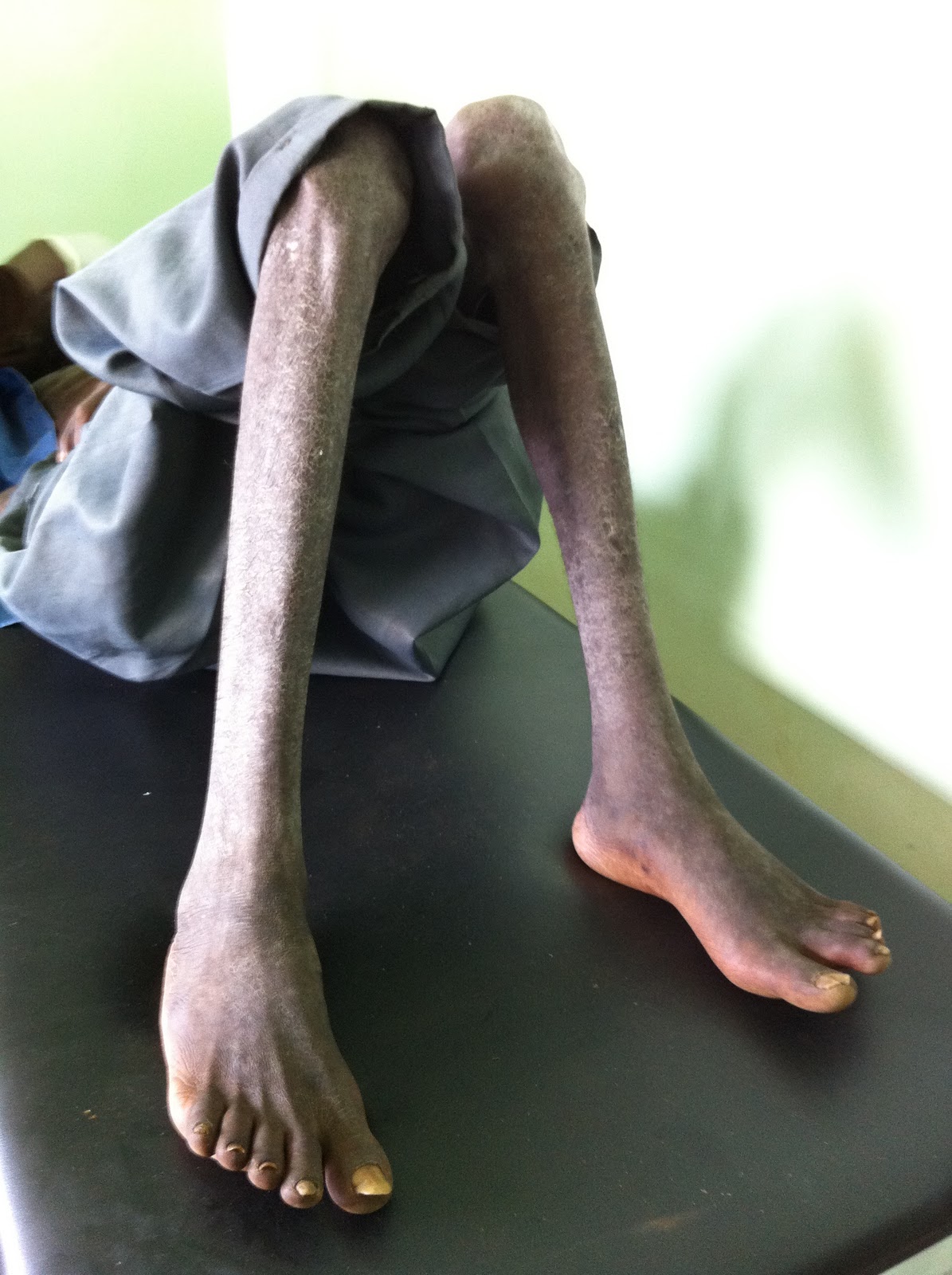
18 years of life, 18 kgs of skin and bones. This AIDS orphan sells his ARVs to people who can't or don't want to register in ART clinics. On the one hand, I am angry that he exploits HIV medicine and stigma, undermining so many doctors' and nurses' attempts at treatment, all the while sabotaging his own health. On the other hand, I recognize that the only way he has ever learned to live is as a sick, poor, and pitiful orphan. Besides, it pays! If he can buy himself a radio or new jacket, he thinks he'll be happy. Maybe he even thinks he'll be normal. I wish someone had raised him to know otherwise, or be otherwise, a long, long time ago.

Wednesday, March 21, 2012

Next time I will carry a camera on my run

A water tanker.
Chipped paint, vanishing in the dusk,
an old sign announces its importance:  WATER IS LIFE.
A crack.
Rusted and unpatched, the tanker leaks.
Water dribbles and escapes; no one seems to notice.
A pool.
Forms, fills, then overflows on the ground.
It spills into the street, as more water tumbles on top.

If water is life, then what is this?
A rivulet.
Breaks away, sparkling under headlights.
Forges a path down the hill, only to be smashed by spinning tires.
A life.
Silhoutted against the neon glare, I see
this tiny frame hunched between petrol pumps under a basket of bananas.
A child.
She watches my approach, lifts her gaze, hopes I will stop.
I don't know how to tell her, this life is leaking and spilling beyond control.

But, I stop.
We say nice things.
She smiles.
I buy some bananas,
and
the fruit is sweet.

A light.
In the darkness, a stream trickles past.
Small and courageous, undeterred by traffic and tires, it is still shining in the night.


50/50


When you ask a Ugandan how he or she is doing, there are 4 possible responses:
(a) Good
(b) Okay
(c) Fair
(d) Fifty-fifty

Fifty-fifty used to bug me. It seemed like the blandest of responses; an elaborate "mehhhh". But I've come to think differently. When someone tells me that they are "fifty-fifty", he/she is saying that the day has been split between opposites. Now that makes sense. In this world of extremes - each day layered with moments of effusive joy and hopeless sadness, sweetest pineapples and deepest potholes, stimulating research ideas and frustratingly slow internet connections that make their transmission near-impossible - the balance may come out neutral, but the experience never is.

Monday, March 12, 2012

Siriimu and fats

The Luganda word for HIV/AIDS is "siriimu". This might not mean anything to you at first, but then let me tell you that in this language R's are pronounced like L's; now you can read it as "silimu", or "slim". HIV/AIDS:  the disease that makes you skinny.

Advanced HIV infection, both alone and in combination with other illnesses that often occur with it (particularly TB), causes wasting. Wasting is more than undernutrition; by definition, it cannot be reversed by nutrition alone. It is the result of a chronic disease process involving a high metabolic state due to constant inflammation in the body, made worse by opportunistic infections in the gut that cause diarrhea and malabsorption. (Actually, a lot of what is known on this subject - ie, cell signaling molecules like tumor necrosis factor alpha, TNF-a, that are thought to be major causes and treatment targets for wasting - have been discovered through research on end-stage cancer. Cancer wasting is also called "cachexia".) Because lean body mass is disproportionately lost in this process, people who are wasted look different from people who are just really skinny. Loss of their facial muscles leaves noticeable depressions around the temples and jaws:
Moderate temporal wasting in an HIV-positive woman
In Uganda, where HIV is fairly prevalent, divots on both sides of someone's face should make you think of HIV/AIDS. (Where HIV is rare, you would think of end-stage cancer.) Many of our sickest clinic patients had profound temporal wasting before they started antiretroviral medications (ARVs). And outside of clinic, while boarding a taxi in Kampala or grabbing lunch in a restaurant in Kiboga, it's not uncommon for me to catch sight of a skeletal face and mentally diagnose advanced HIV.

That said, the appearance of siriimu is very different today than it used to be. When advanced HIV got the name of "slimming disease" there was no treatment for it, and skeletal faces must have been everywhere in the streets and hospitals. These days, ARVs are turning the disease process around:  they reduce HIV viral load, increase CD4 immune cell function, stop TNF-a overactivity and wasting, and plump up the faces and bodies of HIV-infected persons. You could say that they are literally "changing the face" of the disease! And this antiretroviral therapy (ART)-associated weight gain can be quite striking. Wasted and tired-looking patients whom we start on ARVs often come back for the two-week check-up with round cheeks and big smiles; at the six-week treatment follow-up, we have documented ~10 kg (22 lbs) of weight gain in several patients. Preliminary data from our study shows that this weight gain continues, albeit at a slower rate, over the first six months on therapy. Our average patient gains almost 3 kg (6.5 lbs) in that time period, and a handful have gained upwards of 15 kg (33 lbs).

Unfortunately, ART-associated weight gain may not be all good. There is strong evidence that certain ARVs cause unhealthy fats to accumulate in the body, both as deposits in blood vessels (a precursor for atherosclerosis, which causes blood clots or vessel narrowing/blockages) and as abnormal distributions of fatty tissue around the body (called lipodsytrophy, which is associated with metabolic disorders like diabetes). The second effect, lipodystrophy, can be easily picked up in a physical exam:  its hallmark signs are fatty accumulation around the abdomen and upper back, plus/minus fatty loss from the face and arms. So we assess body shape and waist-to-hip ratios at every visit, and we also check fasting blood sugar levels to see if our patients are developing diabetes. So far, we haven't seen these kinds of changes - happily, round cheeks predominate over rotund bellies! - but it's too early to conclude anything. Many patients have only completed the early stages of follow-up, so we have a lot more data to collect. Fatty deposits in the blood are harder to detect in a physical exam, but we perform monthly blood pressure checks to get some idea of what's going on inside. We haven't seen any trends toward fatty deposits and stiff blood vessels yet - but again, these changes may take longer to become obvious. In order to answer this question, we are planning a long-term study on heart disease risk, including annual blood tests for cholesterol and other fats and EKGs to assess for heart attacks, that would follow a subset of our patients before and during the first five years on ART.

As you can see, the interactions between HIV, ART, and fats are complex. There is uncertainty around how much weight gain is healthy on ART, how best to measure heart disease and metabolic risk factors in such patients, and how to balance to benefits and side effects of ARVs. Last week we all cheered for a man who proudly waltzed into clinic with 8 kg weight gain in the past month on treatment. But doubt quickly set in. Is that rate of weight gain healthy? Is his new fat in the right proportions and places? Do we really know enough to celebrate? My colleague congratulated the patient and then whispered in my ear, "I just hope that this is as good as we say it is!" Solemnly, I had to agree.

I am not sure about the true nature of rapid weight gain on ART, but hopefully soon an answer will emerge from our accumulated clinical experiences. All the while, it's fascinating to witness the dynamic nature of a disease. In just one decade, since ARVs came to Uganda, HIV/AIDS has gone from "the slimming disease" without any treatment to an impressive plumped-up state on ART. Emaciated patients appeared saved; a solution appeared found. But, now that people with HIV are living longer than ever, we are finding that their additional years are pock-marked with above-average rates of chronic diseases like high blood pressure and diabetes. Our "solution" actually creates new problems. Yes, these are secondary concerns - better to have heart disease at 60 than be dead at 26 - but still they are serious, and they are going to affect millions.

Through this unfolding tale, I am reminded that medicine is the eternal student of the human body, A Quite Mysterious Teacher! As we try to understand the body's complex responses to every intervention we create - a new chemical to swallow, a diet to control all inputs, an operation to modify or remove organs, a few blasts of radiotherapy - we must be humble, ask questions, take good notes, and be ever-ready for the next surprise lesson.

Tuesday, February 7, 2012

There must be dust: Part 2

The dry season is well upon us, and it sure is dusty! It is also rather hot, ringing in at 35 deg C (95 deg American) this afternoon. But today, I realized 2 unexpected advantages to this extreme weather:

  1. You can tell how far people have traveled. Clean = short distance, dusty = considerable distance, dirty beyond recognition = at least a few hours on the road. One of our patients today tried to swindle an extra travel reimbursement by claiming a long commute to clinic. This was news to us, as we thought she lived nearby. So the study nurse examined her feet (clean) and hair (not even lightly dusted) and concluded that she must actually live quite close. When we confronted the patient with this irrefutable evidence, she laughed and confessed - okay fine, Dust Detective, you saw right through me! She left the clinic with a sheepish smile and no swindled money. The rest of the clinic chuckled, knowingly, like this happens all the time. And I enjoyed seeing how this little bit of local knowledge has become a new lens for me to tell something about the journey of the person I'm with.
  2. The water runs warm. Our tank in the village usually provides a steady stream of cold water for bathing, showering, and other activities that make me shiver - but these days, it's solar-heated to a perfectly refreshing temperature! Ahhhhh.

Expat expose -slash- Invitation to visit the developing world


In the last post, I mentioned my Kampala bubble. You might have wondered what I meant by that. Well...

Projections
As I departed San Francisco, I put on a brave face as we talked about squat toilets, stray dogs, and the horrors of a death by rabies. You read articles about maternal mortality, corruption, and fighter jets in Uganda, and emailed me links to said articles while expressing concern for my safety. I have written back with real stories about dust, potholes, and death and disease. These are the dominant projections of Uganda to the rest of the world, of a harsh and difficult place. Many of them are spot-on. But I must admit, there is so much more to my life than that! 

Realities
      > Lavish luxury
The cushier, less talked-about aspects of my expat experience include but are not limited to:  Deluxe Geodome vacations on serene lakes in the beautiful West; weekends at the pool with a swim-up bar and sauna in the changing room; an idyllic farmer’s market with wood-fired pizza picnics on the lawn, and a background of United Colors of Benetton children chasing bunny rabbits around palm trees; unprecedented responsibility at work and privilege in social settings; and wonderful, friendly, helpful people to clean floors, dishes, clothes, cars, bikes, and even take out the trash.

Deluxe Geodome at Lake Bunyonyi
Deluxe geoviews from our dope dome balcony
Clearly, we are not deserving! We belong at the kids' table
Artsy market selling "cheeses, ...jams, ...stone-baked breads". In my language, these words mean "everything you miss"
      > Comforts from home
In September I attended a Rosh Hashanah dinner in Kampala, with all the good cheer and food of this holiday - and none of the Manischewitz. Ideal! Soon after it was time for Oktoberfest, so a large crowd gathered at a fancy hotel, danced in circles with felt hats and lederhosen, drank real German brews, and ate tons of sausage. When in Rome? Apparently, not so much! On any day of the week you can visit Bubbles O’Leary, a bar that serves continental fare and imported its dark wood interior from a real Irish bar in - yup, Ireland. And we've got a Belgian cafĂ© and bar, yoga studios, a few gelaterias, casinos that look straight out of Vegas, and heated debates about the best pizza in town (sound like NYC? well, almost. people just love a good squabble).

KA-M-PA-LA-H in Hebrew letters
     > Local perks
All this, and that's before I've listed off a few of the joys that naturally occur in foreign places. There are perfectly ripe and unbruised avocados at 10 cents a pop. Just out of town in any direction, you'll find green hills - and in one direction you might even run into The Nile, a beautiful and calmly raging river. The streets throb with lively music, the markets are bursting with color, and everywhere waft the smells of roasting meat and carbohydrates to infinity. Travel has given me the gift of an international network of friends, as well as the chance to do meaningful work in challenging situations with inspiring people, where I learn so much every day.

Hairy Lemon island resorts splits rapids along the Nile, and is easily a favorite getaway
These people alone make the trip worthwhile
If you have ever felt sorry for me, or for your other friends living in the developing world, please ask yourself these questions:
  1. Does your friend rave about having found “the best latte EVER”, “heavenly pedicures!”, or the joys of a personal cook “I just can’t live without”?
  2. Do days go by when you don’t hear from that friend, assuming it's because she’s got malaria or he’s saving babies at an orphanage – only to see that friend's grinning face resurface in photos on Facebook from a weekend on a lake with beautiful flowers and neon sunsets, or white tablecloth dinners and cocktails on the beach?
  3. Is your friend becoming proficient in things like tennis, croquet, and wine?
  4. Has he/she ever Skyped you from a private balcony, fresh mango smoothie in hand?
If you answered no to all of these questions, then maybe your friend is truly living it rough - but probably you just need to get in better touch. On the other hand, if you answered yes to any of the above, then it's safe to say that your friend is living a glorious expat life!

Reconciliation
This "expose" does not mean that potholes and disease don't exist - for they do, as world news and the rest of my blog attest. My chances of experiencing badness (robbery, infection, sunburn, motor vehicle accidents) are definitely increased in Uganda as compared to the United States. But these risks can be minimized to almost baseline! Take disease, for example:  The well-vaccinated traveler may fall victim only to short-term diarrheal discomfort, the sort you can pick up at any roadside Chinese buffet. I've been pretty lucky on this front, which I credit to simple things like hand sanitizer, no meat, and a stomach of steel. As for road risks and safety, here's a story from this weekend:  While sitting in a broken-down matatu filled with smoke coming off its overheated engine, my friend and I joked that our odds of getting cancer from diesel fumes had just increased from 0.0021 to 0.0025. We laughed at this joke, because the situation was ridiculous; then we made serious faces to each other and sighed, "Yeah, but for real. Let's go before this engine blows." We stepped off of that smoking gas tank, which had been our ride, and 5 minutes later caught a safer matatu for an extra 50 cents. In the end, we reached our destination safely. I did miss my next bus, but it was totally worth it. Unpredictable events and inefficiency are inevitable in travel, and a desire to minimize risk has made me much more tolerant of these compromises.

Smokin'  'tatu
The bottom line is that most expats enjoy more than enough privileges to smooth out the rough. And when the going does get rough, the biggest luxury comes from having the means to decide when to live like everyone else, and when to check out. Further luxuries give us options as to how to check out. "What a stressful day! To unwind, shall I watch a movie on a home projector, snatch some quiet hours by the pool, or make a picnic from a loaf of crusty bread and soft cheese as bunnies hop past?" Some developing world places don’t have so many options, and some have almost too many to be considered rough. In my opinion Kampala is somewhere in the middle, just rough/plush enough to keep it always interesting.

Strong women depicted by a strong woman, artist and patient in the IDI clinic
"What a stressful day!"
...and here I am carrying a fraction of the burden, for 10 seconds, without even a single baby on my back
So, the punchline? Stop feeling sorry for your dear friend in a developing country! (Especially if it's me.) Go get your shots, pack a bag, and book a ticket to visit him/her in some place new. It sounds crazy, but I’m serious – the money you spend on vaccinations and plane flights, you will make back on luxury safaris, spa treatments, and tailor-made suits that would cost a fortune anywhere else. (That is a pretty sweet deal.) You will also see poverty and suffering like you can't imagine, bear witness to some of the world's greatest disparities, and gain a new appreciation for the resilience of the human spirit. (This is my invitation.) Developing countries could not be happier to have more visitors. In exchange for giving them that, you will have the experience of a lifetime.

Wednesday, January 18, 2012

So, a Christian, a Jew, and a Muslim sit down for tea...

No joke. It was a day after work last week, and a Christian (our medical officer), a Jew (myself), and a Muslim (our lab technologist) sat down for tea. We plus Marion (the study physician and my Fogarty twin) all live together in the Kiboga project house, for 2-4 nights each week. At first I thought this arrangement was purely practical, but increasingly I appreciate how the house brings together different people to form a diverse community. In fact, the house is one of my favorite aspects of the job. I love coming home to socialize with my coworkers, eat their chapattis, battle darkness with fire and wax, and hear the latest translations of Ugandan local television news. (Thanks, Marion - I am especially grateful for the chapattis!)

Last week's conversation is a good example of how this house provides experiences I just wouldn't have in my little bubble in Kampala:

First we discussed the composition of the Earth. The lab technologist pointed out that it is commonly described as 2/3 water, so it's strange that all this worldly water does not slosh around the middle or fly off the surface. I took the opportunity to brush off some old knowledge on gravitational forces, ocean currents, and the hot boiling lava inside Mother Earth. Easy.

Second we turned our gaze up to the stars and wondered what else is up there. The Christian was always told that Heaven is in the sky, but he asked what that means - among the stars, or beyond them? And could he get there in a spaceship? We pondered this quietly for a moment. Not so easy. Then the Muslim shared that in Islam there are 7 Heavens, each with a different gate and gatekeeper. Are they the same as the Christian Heaven? Would these 2 friends be able to meet each other there; and, if so, behind which gate? More food for thought. After a while, I suggested that maybe Heaven is a place inside all of us. (Judaism is not so concrete on the afterlife. The Book of Life keeps us accountable in the present, but what happens next is very much based on personal belief.) My proposition was the most foreign so far, but the others considered it for a minute. Finally we agreed to put this complicated idea to rest and move on to "simpler" topics.

And so we arrived at G-d; basic questions like who He/She is and how to find Him/Her. The Christian wanted to discuss G-d as the Omnipresent. His religious teachings said that G-d is everywhere but impossible to localize. With genuine uncertainty, he asked, if localization is impossible - does that really mean that G-d is nowhere? I had no good answer; likening G-d to electrons seemed awesome and, at the same time, far too prone to misinterpretation. The Muslim wanted to discuss G-d as the Almighty. How much control do we really have over our own lives? And if we keep asking these questions but G-d does not intend for us to find the answers, will we ever know the Truth? Again, I just listened.

This got me thinking about faith, and how that is just it - unending belief in a Truth that you may never know. Faith is funny. While inherently irrational and deserving of suspicion, I have seen it act as a great force of positive action in Uganda. For example, irrational belief in good outcomes has motivated many of my colleagues and patients to work against the odds. Driven by the strength of their beliefs, they invest in hopeless cases and save lives that others have long assumed over. Faith has basically wrought miracles before my eyes. I'm not sure exactly what religion I ascribe to, what constitutes the Heavens, or where G-d can be found - but I do believe in faith.

Just then, we heard scratching and squawking at the front door. Since we weren't on the brink of Total Truth, Divine Discovery, Absolute Epiphany, or any other regular noun requiring capitalization, I got up to see what it was. Maybe it could help. A message from G-d?! A clue to the Truth??! Maybe, but I think not. It was just another lost and wandering chicken from the farm next door.

For reasons unclear to me, the chickens do this a lot. One after another, they will leave their chicken paradise, with all the cushy nests and nutritious grain a bird could dream of; meander across the road; and trap themselves in our barren yard, with nothing but a collapsing chicken coop and a bed of dusty greens. Some may chalk this up to chicken stupidity - and yes, you are probably right - but, just for fun, I want to give these chickens more credit than that.

Crossing the road to see what's on the other side, after all, may not be as lame as I used to think. All of us who walk into murky waters and ask questions with no certain answers seem to be doing just that! With a whole new (and perhaps delusional) fondness, I watched that stupid bird peck our dirt. Then she must have decided to go home, because she ran into a few concrete wall dead-ends, dusted herself off, and finally pecked back to and out of the gate. So graceful. Farewell, Intrepid Hen!

I do appreciate this house, and sometimes it really does feel like a home - but this ain't no Heaven, apparently not even for a chicken. (Actually, that's reassuring; Heaven should have regular power supply, potable water, dark chocolate, and no mosquitoes.) Still, like that chicken, I think it's worth crossing the road to find out for oneself. And I'm so very glad to be here, across a huge watery 10,000-mile road from home - making friends, asking big questions, finding faith, trying to do good work, feeling small but empowered, and generally enjoying life - with a bar of dark chocolate I packed for the journey.

Wednesday, January 11, 2012

There must be dust

In the words of a Ugandan:  "Kiboga is extremely hot, dry and dusty. The green of the countryside is slowly fading into a brown rocky landscape, which I am slowly coming to terms with..."


In the words of an unseasoned Mzungu:  "Damn, it is 200 degrees here! Yeah, and I do mean Celsius! Can someone pass me a popsicle, please?"


I'm just back from holiday break in Bangladesh and Thailand - both countries known for their heat, even in winter - but somehow the climate in Uganda has knocked me over. Must have something do the equator and proximity to the sun; geometry, you know. And physics and stuff.


Anyway, I went for a run through the village this morning and came back with a coating of dust that could have passed for a fake spray-on tan. If only the sock lines had not given me away, I could have taken myself straight to the Jersey shore! When I blew my nose, dry red dust came out. Ten minutes later, the water from my shower ran red. My white running shirt is permanently brown. And this evening I picked some greens for dinner, but they looked more like browns. Had to go through the following rinse cycles to get them clean enough to cook - 1 (brown run-off), 2 (brown again), 3 (red, a sign of progress), 4 (orange, almost there!), 5 (finally clear). Good to go. I just fear for the day when the dry season means a water shortage, which it soon will.
Just back from a run - how did you know???
They say that the dry season will last about 3 months. Time to buy a dark-colored shirt that will swallow up the dust and enjoy some mangoes! Oh yes, and popsicles - I am totally freezing guava juice when I get home.

Saturday, November 19, 2011

Hunger is the best sauce, but the worst medicine

At the end of a long clinic day, as we tuck into our all-too-familiar plates of matooke, rice, and beans - with salivary glands churning in overdrive, stomachs grumbling, taste buds exalting - we like to say that "Hunger is the best sauce". Even these dishes, which are very mildly spiced and occur in identical fashion every day, taste wonderful. I lick my lips; I rub my belly! Anyone who has eaten reconstituted refried beans on the top of a mountain and thought that they were experiencing culinary nirvana, knows exactly what I'm talking about.

Beyond the point of making your meal taste a little better, though, hunger becomes dangerous. Extreme hunger is even lethal. This problem occurs mainly among rural, impoverished, and sick or isolated individuals. Most rural Ugandans are vulnerable to hunger because they participate in subsistence farming, cultivating small plots of land that supply just enough produce to put food on the table each night. (Or each morning, as 1 meal a day is standard for the very poor.) When someone becomes sick and can't manage the garden, or is socially isolated and can't benefit from community harvest, hunger sets in. From here, things usually get worse:  the hunger causes weakness, and weakness leads to more hunger, which leads to greater weakness, which leads to more hunger, and so on.

Lack of food is the beginning of an especially steep downward spiral for our HIV-positive patients. They all have to take daily medications to keep their HIV infections under control and prevent other opportunistic infections. Since antiretroviral therapy (ART) needs to be taken with food, many become "ART non-adherent" or "defaulters" when food is scarce. HIV then rises up, out of control. Other infections like TB, PCP, and cryptococcal meningitis can pounce. The body becomes weak, wasted, immune-compromised ... and people perish. While every patient in our clinic is technically living in poverty, the ones who struggle to eat are the poorest and sickest.

One woman, NA, used to complain of "dizziness" whenever she spoke with clinic staff; this was her way of letting us know that she was lightheaded from not eating enough. Then, last month, she stopped coming to clinic. When our community health worker went to her village (a full day's journey - 120 km round-trip on narrow dirt paths) to find out why she was missing appointments, he found NA on the floor of the family's mud hut. What he saw, when he looked inside, is not captured by the simple words "weak" and "wasted". There lay a young woman, previously plump and smiling, reduced to a 2-dimensional shadow of a body on the floor. She was nothing but skin and bones, literally, with her breast tissue so completely consumed that only 2 wrinkly sacks of skin were left hanging from her chest. The tuberculosis infection had taken root in lymph nodes throughout her body, causing swollen nodes and large abscesses in her left armpit and under her chin. Both were draining blood and pus. NA's left arm, held for so long in a crooked position while she was ill, had developed a contracture - the skin grown taught across the inside angle (like the kink in a chicken wing) so that she couldn't extend her arm past 90 degrees. Too weak to stand, NA was carried out of her village in a stretcher. We wasted no time in admitting her to the hospital and starting treatment for TB. But, of equal importance I think, recently we added to her treatment plan an allowance of 5,000 Ugx (about 2 USD) per week to afford some food. Now she is eating better, undergoing observed TB and HIV treatment by the nursing staff, and doing self-physiotherapy for her arm. Her weight has increased to 27 kg. She can almost stand alone. Her left arm extends to 120 degrees. A finished plate of food rests on the bed beside her head. Things are looking up! NA's goal for discharge is to walk back into the village on her own 2 feet, and we couldn't agree more.

Another severely wasted patient came to us 2 weeks ago with signs and symptoms of a brain injury. Like the young lady above, NG had run out of money and strength for food and stopped taking his ART. While his body degenerated from hunger, weakness, HIV, and possibly other infections, he suffered one additional blow:  struck by a motorcycle while crossing the street, there was report of a serious hit to the head. When one's reserves are so low, all it takes is a single unlucky event to put the body over the edge; infections are not the only threats to the immune-suppressed! By the time his family carried him into clinic, NG was disoriented, losing motor control of his limbs, and had a coarse tremor in his arms and lips (signs of cerebellar, brain coordination center, dysfunction). Needless to say, he was also just skin and bones:

Instead of buying new clothes, people here tie cloth bands to keep loose pants from falling off the waist. You can tell how much weight one has lost by counting the number of bands he uses. This man needed 3 strips of cloth, tied to his belt loops and wrapped around his waist, to hold up his previously well-fitting pants.

We ran through the possible causes of brain injury in such a patient:  certainly trauma to the brain from the motor vehicle accident could have caused a bleed into his brain, but brain infections are also common in people who have stopped taking ART. Through an incredible (and I really mean in---credible) triumph of the public health system, we managed to transport NG to Mulago in Kampala and get him seen by the neurosurgeons. They determined that he had a brain abscess and performed emergency brain surgery the following day. Last Tuesday we visited with NG at home. The 40-year-old man who greeted us - sitting up, smiling, eating plantain stew, with a well-healing scar on his lower scalp - was barely recognizable from the 70-year-old-appearing limp skeleton that we had carried into Mulago last week. With antibiotics, and of course another 5,000 Ugx per week to keep food on the table and ART in his body, we hope that NG will continue to recover.

Now that NG can speak again, he has told us another amazing story.

It all started with our question, How did you come to clinic that day 2 weeks ago? Dropped off by the ambulance that was carrying my mother to Kampala. Your mother, oh...what happened to her? She was burned. Hmm, I see...well how did she get burned? Now the story unfolds!!! NG explained to us that about 4 weeks ago, just after his accident, no one was home but himself (bedridden), his mother, and a young girl attendant. While fetching water outside, the old lady reportedly fell down and started shaking - what sounds like a seizure. Reason's unclear. Anyway, the girl heard the noises, went outside, found the woman convulsing, and called the local witch doctor to come give treatment. When the witch doctor arrived, he said that her seizure was caused by evil spirits. These spirits, he announced, resided within the woman's chest and needed to be burned out. The woman was lying prone (face-down) on the ground, so he stuffed dry grass under her body to fill the space between her breasts and the earth. Then, with a crowd of villagers gathered all around, he set fire to the bundle. When the last of the grass had burned out, the onlookers came and turned the woman over. There they discovered a gruesome mistake:  her chest was raw, weeping, and - once endowed with a generous bosom - now completely flat. The witch doctor apologized for her injuries and promised to help with the wound care. The old woman was carried inside and laid down to rest. For the next 2 days, the witch doctor hired a local nurse to apply antibiotic ointment and change the bandages. But on the 3rd day, instead of fetching the nurse, the witch doctor ran away into the hills. Without proper wound care, the old lady's chest became infected:  first superfically, then deep into the tissue, and finally spreading into her bloodstream. Within a week, her whole body was septic. All the while, NG was deteriorating on the mat at her feet. It is hard to imagine a more hopeless situation:  mud hut, empty food shelves, not a shilling to spare, abandoned by the witch doctor and forgotten by the local nurse, a son with a brain infection and his mother with an infection everywhere else. Then, out of nowhere, the ambulance appeared! We still don't know who procured that ride.

These stories are hard to believe and may seem totally unique, but - if you have time to listen - every person you ask has similarly unbelievable stories. I am reminded of the mottos from San Francisco General Hospital,
 As real as it gets (official motto)
You can't make this shit up (unofficial)
which, taken together, mean that real life is the strangest. From San Francisco to Kiboga, I have found this to be a universal truth.

So, allow me to organize my thoughts from this very long blog post:
Real life is unreal.
Enjoying hunger as a delicious sauce is a privilege and a luxury.
Recognizing hunger as a lethal global scourge is much more important; in fact it is a necessity.

As we head toward the American day of thanks and feasting, it seems appropriate to remember that there are basic material needs that we, all humans, share:  food, water, access to information, and access to quality health care. Our patients' lives have shown me that providing support for these needs is not only simple and cheap, but also at least as important as any other global health intervention.

My country life

Long time. Maybe it's the slow pace of life in Kiboga that has kept me from whipping out my computer and cyber-reporting every major event. Eh...more likely, it's the lack of electricity and lack of time...but no matter. My computer is fully charged today, so this blog is back!

Let me start with some photos from the past few weeks.

My walk to work is a mere 10 minutes, but in that short time I pass a petting zoo's worth of animals. It's a good test of coordination at the start of each day:  don't trip over the goat's tugged cord, don't kick a chicken, and please don't step in poop! In addition to coordination, I have learned a lot about our friendly animal neighbors. 1) Pig poop smells much worse than cow dung, so beware of the careless cow dung side-step that lands you in a pile of pig poison. 2) Chickens will eat anything, including all the greens you planted in the garden. Ugh, and I thought they just chowed on grains! 3) Sheep have very wide and floppy tails. I don't think this fact is widely recognized, but take a look at the back of this here sheep - he practically has a beaver tail. 4) A bull's horns are like a human's lips. When they grow curving upward, the message is strong and proud, like a confident smile. On the other hand, for the bull with the down-growing horns, depression is almost certain. Not only does he have to wear a permanent frown on his head, but it's a frown that weighs 10 kg. How unfortunate you are, my poor bovine Eeyore.

One morning last week, I decided to paparazzi all the creatures I see on my petting zoo commute: 


The beaver tail! Does anyone else think this is so weird?!?


On the way home from work last week, we spotted a rainbow:


And here's a tree outside the hospital that caught my eye in the dusky evening glow:

 (These round metal huts are standard lodging for policemen and their families)

Sunday, October 23, 2011

ROTW (5,6,7...now I'm almost caught up): Blendin' stuff

  • The Eskimos have 400 words for snow.
  • According to Jonathan Safran Foer in Everything is Illuminated, the Jews have 400 words for schmuck. (My Yiddish-expletive-fluent grandma could attest to this better than I, but I think it's close to the truth.)
  • According to me, hot days have 4 words for heaven:  smoothie, crush, milkshake, and icy blended beverage.
Today was hot. Really hot. ... So ... Guess what I did??????


ROTW (5):  When you buy a large PAPAYA (and when do you not? I picked up the smallest pawpaw I could find in the market today, and it was - as my friend puts it - the size of a small child)

Ingredients
1 cp chopped papaya, juice of 1 lime, 1/4 cp mint leaves, 1 tsp grated ginger (or ginger crystals), 1/2 cup milk, honey to taste

Instructions
Blend the stuff. Garnish with mint leaves. Eat!

ROTW (6):  When the AVOCADO is so soft it might melt in your hand, and you feel like drinking a meal (but it's still too early for beer)

Ingredients
1/4 large avocado, 1 small banana (equals 1/2 regular banana), splash of water, honey to taste

Instructions
Blend. Eat!

ROTW (7):  Whenever - seriously, WHENEVER - you have PASSIONFRUIT on hand (sadly I polished off my last one this morning, but this would have made trip to heaven #3 of the day)

Ingredients
2-3 small bananas (peeled, cut, and frozen if you thought this far ahead), guts of 2 passionfruits, 1 cp plain yogurt

Instructions
Blend. Eat!

Now I know that some of these might sound weird, but don't be a schmuck - putz, schmendrik, or schmo - and knock it before you try it. Just blend and eat, then tell me how it was.
And by "it", of course, I mean your trip to heaven.

Saturday, October 15, 2011

Why Kampala is crazy (1): Islam and boxing

I think I owe you some stories about Kampala, and why it is one cRaZy city.

I want to tell you a story about boxing, boxing and Islam, and boxing and Uganda.

Boxing and Islam have an interesting (if not entirely consistent) connection. - Remember Cassius Clay, the most famous of all boxers, who converted to Islam and became Muhammed Ali? - Did you know that Mike Tyson, famous or infamous boxer that he was, also converted to Islam? - Now I have met a pair of twins in Kampala, Hassan and Hussein Khalil, who both are devout Muslims and former boxing champions. They tell me that boxing is considered the ultimate sport in Islam. It requires strength, but also strategy. You need to have speed, but also stamina. As a sport for individuals, it tests personal fortitude and self-sufficiency. Discipline. Timing. Dedication. Both physically and mentally, boxing is - to be brief - JUST PLAIN HARD.

I was curious about the history of boxing and Islam, so I did a quick Google search. I was surprised to find a web-world of questions about whether boxing is even allowed in Islam. Allowed? Really? Again to my surprise, many Muslim scholars are of the opinion that competitive boxing is not compatible with Islam:
According to a juristic rule in Islam stating “Taking a lawful act as profession is permissible, save what’s made exceptional by a clear proof”, sport is basically permissible in Islam, if not obligatory. The Prophet, peace and blessings be upon him, urged his followers to practice some sort of sport and exercise that help keep the body fit, as long as that it doesn’t entail harm. 

As for boxing, it is permissible if it’s taken as a mere hobby to train oneself on how to practice this sport, without taking a human being as a target (i.e., one should direct the fists to a punch bag and not to a person). But, one should not think of adopting it as profession. This is not permissible, due to the great harm and untold risk it involves, especially to the body and life of the victim. Islam never allows inflicting harm on any person; Muslim or non-Muslim. This is based on the juristic rule: “There should be neither harm nor reciprocating injury”. 

Besides, boxing entails directing blows to the head and face. This is forbidden in Islam, according to the Hadith of the Prophet, peace and blessings be upon him: “If anyone of you fights (or, in another version, beats) a person, he should not hit him in the face." (Agreed upon by Al-Bukhari and Muslim) 

Looking at the evidence against boxing, it is not hard to realise that boxing must be considered haraam(forbidden) or undesirable to the point of being haraam (Makruh al-Tahrim). The object of boxing is knocking an opponent unconscious by physically hitting him with excessive force about the head, the intent is physical damage to your opponent. At the end of all fights that I have seen, the face is left severely damaged and scarred, we know from ahadith that the Prophet (Allah bless him and give him peace) forbade hitting the face

Narrated Abu Huraira: The Prophet said, "If somebody fights (or beats somebody) then he should avoid the face." [Sahih al-Bukhari Vol III Hadith 734.

and also 

Narrated Salim: Ibn 'Umar said, "The Prophet forbade beating (animals) on the face." [Sahih al-Bukhari Vol VII Hadith 449

[...] When the damage to a person is so severe such as brain damage or worse, fatal, then this has to be considered haraam, for there is no reason to suffer such injuries. Our bodies and lives are anamanah (trust) from Allah ta'ala given to us for safe keeping, they do not belong to us to do as we choose, so we have no right to participate in a sport or any other activity that violates the amanah and whose objective is intense physical damage. 

It is sad to see such people as Muhammad Ali, who once "floated like a butterfly and stung like a bee" now a shadow of his former self (although still has a remarkable dignity about him), Muhammad Ali once one of the finest examples of masculinity coupled with charisma, physical beauty and elegance, an object of pride for the entire Muslim Ummah, now an object of pity and a distant memory of bygone glory. Ironic isn't it considering the current downtrodden predicament of our Ummah? Should a man have to be reduced to this through his own doing? 

[...] Any parent whose child takes an interest in boxing should bear in mind the severe dangers and consider answering for their decision on the Day of Judgement, since our children are also an amanah from Allah ta'ala. The physical training and discipline offered by boxing is excellent and children should be encouraged into physical exercise. Rather than encourage them to do boxing, parents should encourage children to learn semi-contact Karate or Kung-Fu, since the object of semi-contact is not physical damage but to score points by minimum contact, anyone one using excessive force is penalised. Semi-contact Kung-Fu and Karate also teach vital self-defence techniques that are needed in an increasingly violent society and parents should instill discipline and good adab (manners) in their children not to show off the skills they may have learned.  

This seeming disconnect, between embraced boxing among Muslims in Kampala and forbidden boxing in various Islamic online communities, is explained by the next subject:  boxing and Uganda. The love of boxing in this country is so strong, it seems to overwhelms any religious controversy about boxing in Islam. Four of Uganda's 6 Olympic medals have been in boxing. This country has also won boxing medals in international competitions like the Commonwealth Games and the World Championships. Children train at boxing gyms around the city. Boxing is even revered as a peace-making sport, because it channels fighting energy from the streets into organized, supervised activities of self discipline. The Eye (local coupon book/city guide/magazine) writes, "[Boxing is] the perfect outlet for that favourite sporting tale:  rising up from rough surroundings with nothing but yourself and perhaps a little support, putting in your work and making something of yourself".

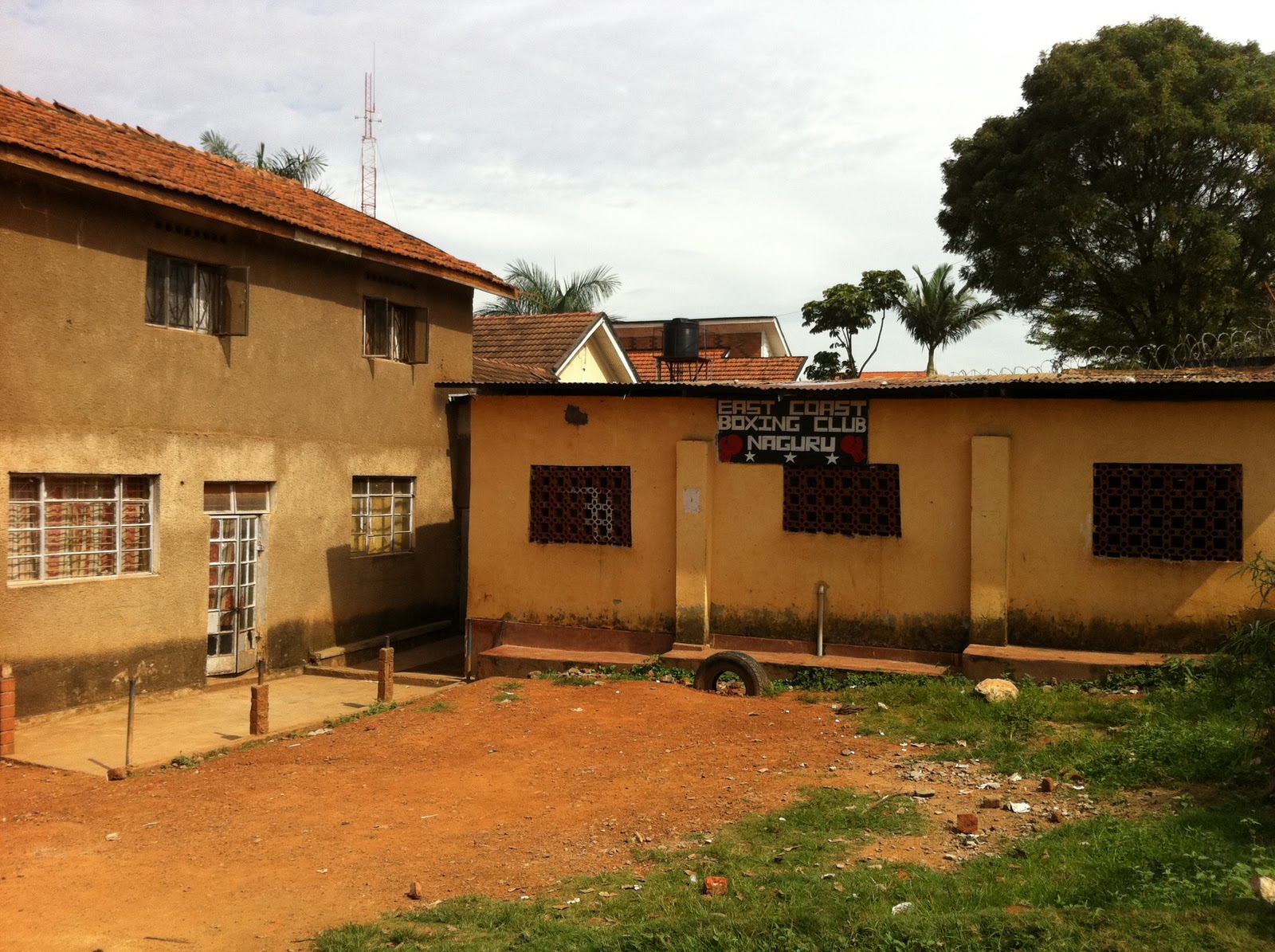
Now for one final surprise:  I have gotten swept up in the Kampala boxing craze. No joke. I bought my own wrapping, and am semi-serious when I say I hope to spar one day! My trainers are Hassan and Hussein, former champions I told you about; the place is East Coast Gym, a very modest but renowned boxing establishment attached to a mosque on Naguru Hill.


Up the hill, past the gospel church, behind the mosque, say hi to the kids, mind that you don't step on a goat
East Coast Gym! (outside...
...and in)
Between prayer calls, the brothers are dedicated coaches. They take us on grueling hill runs, count out jumping exercises and calisthetics until our muscles go numb, and withstand practice blow after practice blow, with pads on their hands, in the newly-roped boxing ring.

Hassan, ready for the punch
Helping us to get the wrapping right - must cover knuckles several times, and make sure to support the wrist
If it's not already obvious from the photos, East Coast Gym is not a boutique Mzungu attraction. This is a hard-core training center.

On any given day at East Coast, I may find myself jumping and punching next to the likes of:  runner-up at last year's heavyweight World Championship (and Olympic hopeful); a member of Uganda's 8-person national team; neighborhood heroes and role models; the one and only female boxer in Kampala; and a blind boxer who bravely returned to the sport after losing his sight in 1995. It is a total trip - and honor - and fright - to be in the ring with these guys and gal. The 5,000 Ugx (less than 2 USD) that I pay for each session helps to maintain the gym, buy equipment, and support competitions for these local boxers.

Just an example of the kind of musculature you can witness at East Coast Gym
My fellow Fogarty in Kampala, Devan, hits hard and runs even harder
POW! BAM! POWPOW! BAM! POWPOWPOW! BAMMM! - it's a busy place


Finally, I should mention that this is the best and toughest workout I have ever experienced. So much adrenaline and exhilaration cannot be found anywhere else - except perhaps on the end of a bungee cord, which I'm just not willing to try.

I know that Uganda supports my new love. In view of the fact that I'm a long way from hitting anyone in the face - and even farther from being able to pack a punch that inflicts any kind of harm - I hope that Islamic scholars, my own religious leaders, and other pacifists everywhere in the world can accept my new love, too.

BAM!


Discontent in Uganda, Uganda in the news

Read this. Real stories about Rolex, political unrest, commodity prices, and stark have/have-not contrast that will probably sound familiar to you by now...

Wednesday, October 12, 2011

Follow-up on follow-up

Photos from Kiboga today:

STRUGGLE

Patients waiting to fill prescriptions at the pharmacy. The wait is usually several hours long, and sometimes can stretch over days. When I told our research assistant that I wanted to show how many people wait for so long, he protested, "But, they are not many today!" Well...you get the idea.

&

SUCCESS

Despite the inconveniences of long travel distances and endless waiting times, most of our patients act with grace and graciousness. We like to think that it's not just because they have great manners, but also because they are happy with the care they receive. Here are the contents of one particularly lovely "bag of thanks" brought in by a patient today.

Saturday, October 8, 2011

Follow-up: challenge and opportunity in HIV testing and treatment

Here's a nice, short article from the New York Times this week, which brings up an important point about HIV diagnosis and care:

Follow-up is key.
And, oh, so tricky.
...

Our study team works very hard to maintain close follow-up with our patients. We see a rural population, so the average patient travels a long distance - sometimes a whole day - just to keep an appointment. Also, since our study population is extremely poor, the price of travel is a considerable barrier. The trip to the hospital can cost over 20,000 Ugx (7 USD) in each direction. That is more than 10x the average daily income, dispensed twice per visit - not to mention the opportunity cost of missing a day in the fields, at work, or at home with the family. We reimburse up to a fraction of this expense, but the money we give cannot replace all the money spent (nor should it, ethically - else we border on coercion). The only additional help we offer is a hospital bed where a patient may spend the night, for free, before traveling back home all day the next day.

Mothers and babies leaving the hospital - how many miles to go?
Considering so many obstacles to care, every visit feels like a minor miracle. So you can see why this (recent data from our interim analysis) feels like a MAJOR miracle:  99% of our patients complete all, or almost all, of their 7 monthly visits. Amazing! They come to get prescriptions refilled, to have a trained ear listen to their heart and lungs. But more than that, I think they come to have a caring hand placed on their shoulder, that hand belonging to someone who knows them well and cares for them, who wants to hear about their pains, their nightmares, their dreams, their families, their hopes for the future. I credit our clinical staff and community health worker for the VERY strong relationships that they create with our patients. This personal brand of medicine brings the doctors and patients closer, and gives the patients a reason to keep coming back.
...

Now, of course, things could be better. We do not have point-of-care testing in Kiboga, as was shown to be so helpful for that clinic in Mozambique, so there is an inherent delay between (a) testing the blood for HIV and CD4 counts, and (b) starting the patient on appropriate ARVs.

In the general ART clinic, the median delay to treatment is just under 3 months. That statistic is obtained by looking at all patients who actually started ART, i.e. those who reached point (b). Meanwhile, a quick glance into the clinic records room would reveal to you a collection of patient files that gather dust in a "pre-ART" section, i.e. the patients who passed point (a) but then got lost. Did they move, transfer, forget, decline, or die before starting HIV meds? We don't know. In truth, many probably died, but these are the hardest patients to find, and their deaths can be very hard to confirm. With such losses occurring but not reflected in the "median 3 month delay", you can see why it is critical to shorten and track patients through the (a) to (b) time.

Row 1, transferred out; Row 2, lost on ART; Rows 3-4, lost pre-ART
In our study, by scheduling the initial 2 visits close together, we have reduced the delay to ART to 1-2 months. Perhaps more important, we keep track of every patient recruited for the study - phone calls when they have a mobile, and "neighbor watch" or home visits if needed - so we lose almost no one between testing and treatment. In the coming weeks I will be returning to the general ART clinic records room to sift through the "pre-ART" files, and try to track those patients to find out what happened to them. Then, with the past outcomes counted, we will be able to estimate how many deaths have been averted with closer follow-up. Looking at those dusty folders, filling 2 whole rows...I think it will be many. I will let you know what I find out!

Filing folders for patients in our study
...

To bring it back to the article:  the shorter the delay between HIV testing and treatment, the greater the number of patients who will actually get the care they need. Innovations like rapid CD4 counts allow for fewer visits, especially in the treatment initiation stage when patients are sickest and most vulnerable. This could save many, many lives.

Still, in the absence of such new tests, our study is proof that the provision of quality medical care - with individualized patient visits and continuity with providers - can be enough to motivate patients to seek care in the most adverse of circumstances.

Combine the strengths of thoughtful, new technologies and focused, age-old patient care, and we may finally see how much better things can get.